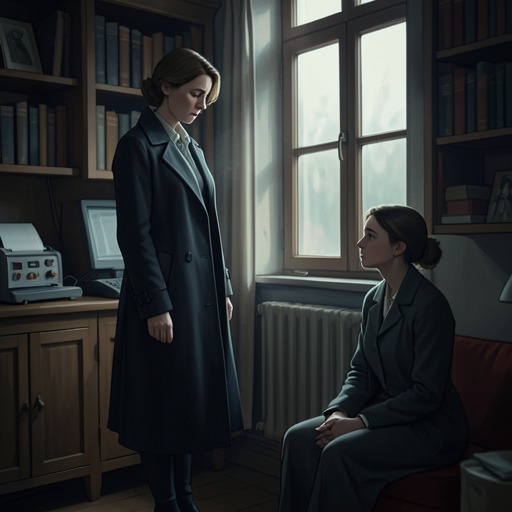
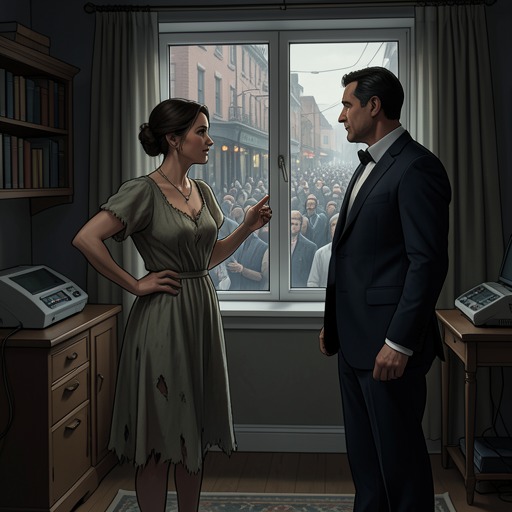
Hana helps Eva Mandl escape her husband
The Glass RoomHana helps Eva Mandl escape her husband through an improvised, carefully staged flight that becomes more than a rescue: in recounting it to Liesel, Hana turns practical courage into a display of desire and a test of intimacy. The episode moves from the Hotel Sacher to a waiting taxi and a veiled disguise, then ends with Eva’s departure by train. Its daring is real, but so is the uneasy mixture of rescue, erotic self-dramatization, and danger that surrounds the women’s choices.
A plan staged like a spy film
Hana tells Liesel that the escape began at the Hotel Sacher, where Eva had arrived accompanied by a woman Hana describes contemptuously as her husband’s watchful companion. Hana waited in the café and slipped away to the bathroom, expecting Eva to meet her there. When Eva did not appear, Hana spent about half an hour in the corridor wondering whether to carry out her contingency plan: rush in, push a Sachertorte into the companion’s face, and seize Eva. The comic bravado makes the danger sound like farce, but the plan’s premise is serious: Eva is not free to leave without getting past someone assigned to accompany her.
At the last moment, Eva emerged after a public confrontation with the companion. According to Hana, Eva had insisted on going to the lavatory alone regardless of her husband’s orders. Pale and frightened, she nonetheless acted for herself. Hana took her by the hand, and the two fled through the hotel’s back entrance, imagining that the companion was pursuing them. Hana tells the scene as a close escape, balancing Eva’s fear against her defiance and her own relish in the dash out of the building.
The extraction depended on preparation as well as quick improvisation. Hana had arranged for a taxi to wait outside the Sacher’s back door on Maysedergasse, its engine running and meter ticking. Inside it were a black suit from Grünbaum and a pillbox hat with a veil from P&C Habig. With the blinds drawn, Eva changed clothes in the taxi, and Hana helped her dress. The costume concealed Eva’s identity and transformed the getaway into a deliberate act of disguise, while the closed blinds offered a small, temporary enclosure in which the escape could continue unseen.
The departure from Vienna
Hana says that by the time she had brought Eva to the Nordbahnhof, the veil had made her unrecognizable. They had reserved a private compartment on the train. Their route was chosen with the expected search in mind: Hana reasoned that the first place Eva’s pursuers would look would be the Westbahnhof, where trains to Paris departed. Even so, the pair had to wait ten minutes in the compartment with the blinds drawn. Hana recalls that interval as resembling an execution chamber, a sudden shift from the spy-story comedy to the knowledge that discovery could have grave consequences.
When the train’s whistles sounded and it began to move, Eva burst into tears and threw herself into Hana’s arms. The departure marks the practical success of Hana’s intervention: Eva is no longer in the company of the woman who had accompanied her, and the train has carried her away from the immediate reach of her husband’s arrangements. But escape is not the same as a settled future. Eva wants to go to Paris; Hana offers to accompany her, and Eva declines. She says she will write, leaving the next stage of her life beyond Hana’s control and the scene’s immediate resolution.
Rescue, desire, and the story Hana tells
Hana recounts the episode to Liesel later, while the two are in the Café Zeman. Her telling dwells on the mechanics of the getaway—the failed rendezvous, the proposed Sachertorte ambush, the taxi, the disguise, the hidden compartment—as though danger were a thrilling adventure. Yet the narration also notes something strained beneath her excitement, as if the plotting were thinly painted over a deeper fracture. The story’s theatrical surface does not make the fear unreal; it allows Hana to tell a frightening event in a register of comedy and daring.
Hana also makes the account explicitly personal. She says Eva spent the night in her bed and calls this her reward. When Liesel asks why she is being told, Hana answers that she is trying to make her jealous. Her focus shifts from Eva’s safe departure to what the rescue might mean between herself and Liesel. Hana describes the intimacy with Eva in deliberately provocative detail, then asks Liesel to judge which of Eva’s features is most beautiful. The account is thus both a report of action and an attempt to provoke a response from the woman listening.
At the art gallery, standing before a stark image of a headless doll whose neck opens into clockwork, Hana says she has not yet told Liesel the end of the adventure. The mechanical image accompanies a story in which bodies and identities are made to serve a plan: Eva changes clothes under cover, assumes an appearance meant to defeat recognition, and is moved through the city as the concealed object of a rescue. Hana’s insistence on narrating the episode there prolongs its afterlife, turning the completed escape into a scene of disclosure between the two women.
Unequal freedom and the threat behind the escape
The episode’s meaning is sharpened by the women’s unequal material circumstances. When Liesel later presses Katalin about her past with Viktor, Katalin acknowledges that he helped her financially because it was difficult to get by. She rejects the assumption that she should feel ashamed: without work, she could not pay rent, secure a place to sleep, obtain food, or buy clothes for her baby. Her account makes visible how economic precarity can restrict a woman’s choices even when those choices are judged by people who have never faced the same pressures. Hana’s escape plan likewise takes shape around a woman whose movements are controlled by her husband’s orders, although the evidence does not equate Eva’s situation with Katalin’s.
The wider danger becomes explicit when Hana tells a man that her husband is Jewish. The exchange takes place in the Glass Room, whose rational balance and ordered beauty stand in stark contrast to the persecution being discussed. The scene establishes that the threat surrounding the women is not limited to household control: antisemitic policy makes Jewish identity a matter of immediate danger. The later appearance of refugees in the Glass Room, including Katalin and her young daughter, gives that danger a visible human form. The gathered audience looks at the displaced adults and children as they are directed into place; the daughter blushes under their gaze, while Katalin looks back with faint disdain.
At the border, Katalin’s lack of secure documentation turns displacement into a new crisis. When officials examine her passport and visas, they rapidly lead her away toward a hut. Viktor’s attempt to speak for her is rebuffed by a soldier, and Liesel pulls the frightened child close, assuring the officials that the girl is with their party and will be looked after. The scene does not belong to Eva’s escape itself, but it reveals the broader world in which women’s safety depends on fragile documents, money, allies, and the ability to pass through guarded spaces. Against that context, Hana’s staged exit from the Sacher is a successful act of assistance, not a resolution of the forces that make flight necessary.